Agent Available 24/7

What New Real Estate Agents Should Look for in Their First Brokerage
Choosing your first brokerage? Don't stop at the commission split. Here's what new agents should compare: training, mentorship, broker support, culture, full costs, and expectations.
Getting your real estate license is one milestone. Deciding where to begin your career is another.
For a new agent, the first brokerage can influence how you learn the business, who you turn to when you have questions, the resources available to you, your day-to-day working environment, and the costs involved in running your business.
That makes choosing a brokerage worth more consideration than simply asking which company offers the highest commission split.
Current search results around choosing a first brokerage consistently focus on training, mentorship, broker accessibility, culture, technology, fees, lead generation, and compensation. EXIT's content strategy also deliberately separates this informational question from the commercial role of the new-agent recruiting page. The planned /join-our-team/new-agents/ page is intended for newly licensed agents and people starting a real estate career, while this article serves as an educational resource for evaluating potential brokerages.
Before you decide where to hang your license, take the time to understand what each brokerage would actually provide and what it would expect from you in return.
Start With Training, Not Just the Commission Split
Commission matters. It just should not be the only number you consider.
A new agent has a great deal to learn after licensing. Passing an exam and learning how to operate a real estate business are not the same thing.
When interviewing a brokerage, ask exactly what happens after you join.
Does new-agent training have a structure? Is there an onboarding process? Is training live, recorded, one-on-one, or some combination? Does it continue after your first few weeks? Who helps you understand brokerage procedures and the practical side of working with clients?
The phrase "we offer training" does not tell you much by itself. Ask what that training actually looks like.
A useful follow-up question is:
"Can you walk me through what my first 30, 60, and 90 days here would look like?"
A brokerage should be able to explain its process clearly enough for you to understand what you would actually be doing and learning.
Find Out Who Helps When You Don't Know What to Do
Every new agent eventually encounters a question they cannot answer on their own.
The important issue is what happens next.
Ask who you would contact when you need help with a transaction, contract question, brokerage procedure, negotiation, or unfamiliar situation. Find out whether guidance comes primarily from the broker, another experienced agent, a designated mentor, a team leader, or someone else.
You should also understand the difference between training and mentorship.
Training teaches concepts and processes. Mentorship or hands-on guidance can help you work through situations as they arise in the actual business.
That distinction matters when you're evaluating brokerages that all say they "support new agents."
If you're considering beginning your real estate career with EXIT Real Estate Consultants, you can learn more about the brokerage's approach to training and mentorship for new real estate agents on our new-agent careers page.
EXIT's recruiting strategy specifically identifies training, mentorship, leadership, professional development, support, and team culture as appropriate recruiting themes, while requiring that any brokerage-specific claims remain verified.
Pay Attention to Broker and Leadership Accessibility
A brokerage can have an impressive training library and still leave a new agent feeling unsupported if nobody is accessible when a real question comes up.
Ask:
Who supervises new agents?
Who reviews your work when required?
How do you ask questions?
What happens when you need help during an active transaction?
Are there regular opportunities to learn directly from brokerage leadership?
How quickly can you generally expect a response when something is time-sensitive?
You are not looking for someone to run your business for you. You are trying to determine whether you will have access to appropriate guidance while learning how to run it yourself.
This is an area where specific answers are more valuable than promises such as "our door is always open."
Look at the Culture You Will Actually Work In
Culture can sound like a recruiting buzzword until you experience a brokerage where the working environment is either a good fit or a poor one.
Instead of asking only, "What's your culture like?" try to see it for yourself.
If possible, visit the office outside of a formal recruiting presentation. Attend a meeting or training if the brokerage permits prospective agents to do so. Talk with agents who already work there.
Ask them what happens when someone needs help.
Do agents share information and learn from each other? Are newer agents comfortable asking questions? Do people participate in meetings and training? Does the atmosphere you were shown during recruiting match the normal working environment?
There is no single brokerage culture that fits every personality. The goal is to find an environment in which you can realistically see yourself learning, working, and building a business.

Understand the Full Cost of Joining
This is where the commission conversation belongs.
Do not compare brokerages using the advertised commission split alone.
Ask for a clear explanation of the entire compensation and fee structure that would apply to you. Depending on the brokerage and business model, there may be recurring fees, transaction-related charges, technology expenses, insurance costs, franchise-related charges, association or MLS expenses, marketing expenses, or other business costs.
Not every expense necessarily comes from the brokerage, which makes it even more important to distinguish brokerage charges from the other costs of operating as a real estate agent.
When comparing opportunities, ask:
What do I pay? What is included? What would I need to purchase separately?
Then compare the complete picture.
A higher commission percentage does not automatically make one brokerage the better choice, just as a lower percentage does not automatically mean you're receiving greater support. Compensation has to be evaluated alongside what the brokerage actually provides.
Ask for the details rather than making assumptions.
Ask What Technology and Marketing Resources You Will Actually Use
A long list of tools can look impressive during a recruiting presentation.
What matters is whether those tools will help you operate your business.
Ask what resources are provided for areas such as customer relationship management, transaction management, marketing, property searches, websites, digital advertising, social media, listing promotion, and other everyday activities.
Then go one step further:
Who teaches me how to use them?
Access to software is not the same as knowing how to incorporate it into your business.
Also ask which resources are included in your brokerage arrangement and which require additional payment. This makes it easier to compare the actual value and cost of different brokerage options.
Be Clear About Where Your First Clients Are Expected to Come From
One of the most important conversations a new agent can have with a prospective brokerage is about business development.
Ask directly how new agents are expected to find clients.
If a brokerage discusses leads, get specific. Ask how leads are generated, who receives them, whether there are eligibility requirements, whether there are additional costs or referral arrangements, and whether you should expect brokerage-generated opportunities to be a meaningful part of your business.
Do not assume "leads available" means you will receive a steady stream of clients.
More importantly, ask how the brokerage teaches agents to build business independently.
A sustainable real estate career requires learning how to create relationships, stay in contact with people, follow up professionally, market yourself appropriately, and develop repeat and referral business over time.
The brokerage should be able to explain its expectations without promising results it cannot guarantee.
Understand What the Brokerage Expects From You
Support goes both ways.
Ask what the brokerage expects from its agents regarding meetings, training, office participation, prospecting, continuing education, professional standards, production, and other responsibilities.
This helps you determine whether the opportunity matches the way you intend to work.
EXIT Real Estate Consultants, for example, has documented brokerage policies addressing continuing education and regular staff meetings. Those kinds of expectations are worth understanding before joining any brokerage, rather than discovering them afterward.
A good brokerage interview should therefore include two questions:
"What will you provide to help me develop?"
and
"What will you expect from me?"
You need both answers to evaluate the relationship fairly.
Think About the Local Market You'll Be Learning
Real estate is local.
The brokerage you choose becomes part of the environment in which you learn how to serve buyers and sellers, communicate about properties, develop your professional network, and understand the market where you intend to build your career.
If you plan to work in Southwest Louisiana, ask how the brokerage operates across the communities you want to serve. Look at its existing presence, the markets its agents work in, and whether you will have opportunities to learn from people actively working in those areas.
That does not mean you need to choose a brokerage simply because it has the largest office or the most recognizable sign.
It means local knowledge and professional relationships should be part of your evaluation.
EXIT Real Estate Consultants serves clients throughout Southwest Louisiana communities, giving prospective agents a way to learn more about the markets represented across the brokerage's service area.
Talk to Current Agents Before You Decide
A recruiting conversation tells you what a brokerage intends to provide. Current agents can help you understand what the experience is actually like.
If possible, speak with more than one.
You might ask:
What was your experience when you first joined?
What training do you actually use?
When you have a question, who do you call?
How involved is the broker or leadership?
What surprised you after joining?
What do you wish you had asked before choosing a brokerage?
What type of agent tends to do well here?
Listen for patterns rather than expecting every person to give the same answer.
You are trying to determine whether what you heard during recruiting is consistent with what agents experience after joining.
Compare Brokerages Using the Same Questions
When you're talking with several companies, it becomes surprisingly easy to forget which brokerage said what.
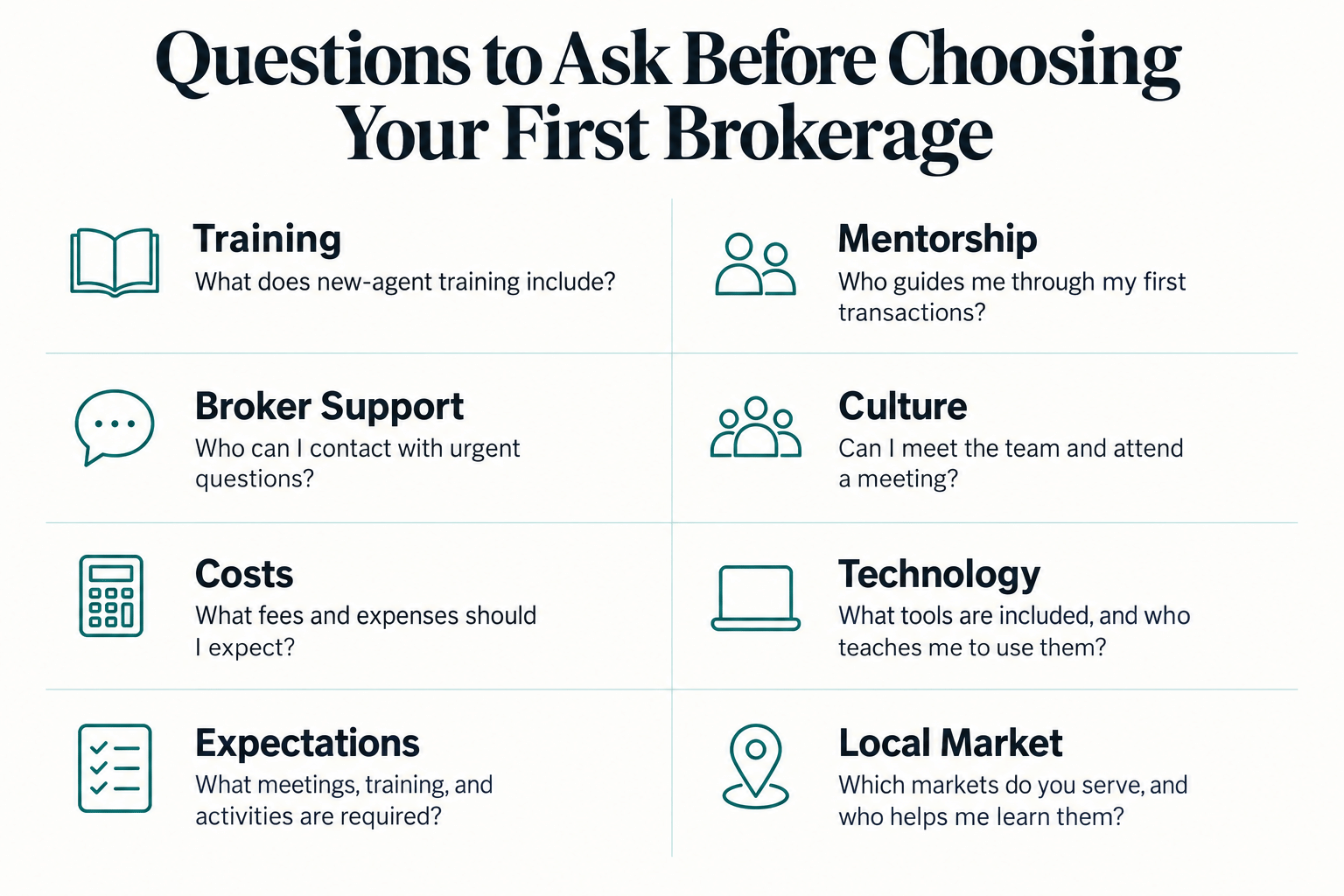
Create a simple comparison sheet and ask each brokerage essentially the same questions.
Include categories such as:
| What to Compare | Questions to Ask |
|---|---|
| Training | What does new-agent training include? How long does it continue? |
| Mentorship | Who helps me through unfamiliar situations and early transactions? |
| Broker support | Who do I contact with urgent questions? |
| Culture | Can I attend a meeting or speak with current agents? |
| Costs | What fees and expenses should I expect? |
| Commission | How does the compensation structure work? |
| Technology | What is provided, what costs extra, and who teaches me to use it? |
| Business development | How are new agents taught to find and follow up with prospective clients? |
| Expectations | What meetings, training, activity, or other requirements apply? |
| Local market | Where does the brokerage operate, and who can help me learn those markets? |
| Growth | What opportunities are available as my skills and business develop? |
This turns an emotional decision into a more useful comparison.
Watch for Answers That Are Too Good to Be True
You do not need to approach every recruiting conversation suspiciously, but you should expect clear answers.
Be cautious when a brokerage relies heavily on promises while providing few details about how those promises work.
Examples worth investigating further include vague claims about guaranteed leads, guaranteed production, guaranteed income, immediate success, or support that cannot be explained beyond the recruiting pitch.
The same principle applies to compensation.
If an opportunity is presented primarily around how much money you could make, ask what assumptions are behind those numbers and what expenses have not been included.
No brokerage can guarantee how your real estate career will turn out.
Your results will depend on many factors, including your effort, skills, market conditions, business development, expenses, clients, and decisions along the way.
A brokerage should give you information that helps you evaluate the opportunity, not make the decision for you.
Your First Brokerage Doesn't Need to Be Perfect. It Needs to Fit What You Need Now.
New agents sometimes approach this decision as though they have to identify the brokerage they'll stay with for the rest of their career.
A more useful question is:
Where can I build the strongest foundation for the kind of real estate career I want to create?
For many new agents, that makes training, accessible guidance, professional standards, local experience, and the working environment especially important.
The right answer will not be identical for everyone.
One person may want a highly structured environment. Another may value greater independence. Someone else may care deeply about being physically present in an office where they can learn around other agents.
Know what you need before you start interviewing. Then make each brokerage explain how it can meet those needs.
Considering a Real Estate Career With EXIT Real Estate Consultants?
EXIT Real Estate Consultants is building a dedicated resource for newly licensed agents and people considering the beginning of a real estate career in Southwest Louisiana. The page is intentionally separate from EXIT's broader recruiting hub and its experienced-agent recruiting content so new agents can explore information relevant to this stage of their career.
If you're comparing your first brokerage and would like to learn more about beginning a real estate career with EXIT Real Estate Consultants, explore our new-agent careers page to learn about the brokerage and decide whether a conversation makes sense for you.
Frequently Asked Questions
Look beyond the commission split. Compare the brokerage's training, mentorship or hands-on guidance, broker accessibility, culture, technology, costs, business-development expectations, local presence, and expectations for agents. Ask specific questions about how each area works rather than relying on general recruiting claims.
Not automatically. Commission is important, but the percentage alone does not show the complete value or cost of a brokerage. Compare the full fee structure and what you receive in return, including training, support, resources, technology, and other services relevant to your business.
Ask what your first few months would look like, who helps with transaction questions, what training is available, how compensation and fees work, what technology is included, how new agents are expected to generate business, what the brokerage expects from its agents, and whether you can speak with current agents before deciding.
Hands-on guidance can be particularly valuable when you're encountering situations for the first time. Ask who will be available to help, what that person's role is, and how the brokerage handles questions during actual transactions. Do not assume that a brokerage using the word "mentorship" provides the same type or level of guidance as another.
Spend time around the brokerage if possible. Attend a meeting or training, visit the office, and speak with current agents. Pay attention to how agents interact, how questions are handled, and whether the everyday environment matches what was described during recruiting.
Yes. Comparing multiple brokerages using the same questions can help you understand the differences in training, support, culture, expenses, compensation, expectations, and resources before making a commitment.

DeRidder Office
1909 N Pine St, DeRidder, LA 70634
Phone: 337-463-1000
info@exitrealtyla.com
Office Hours
Mon – Fri: 8:00 AM – 5:00 PM
Sat: 8:30 AM – 12:30 PM
Sun: Closed
Copyright © 2026

Each office independently owned and operated. Licensed by LREC. Wayne Hall, Owner/Broker. 1909 N Pine St. DeRidder, La 70634. (337)463-1000.
Powered By
Privacy Policy